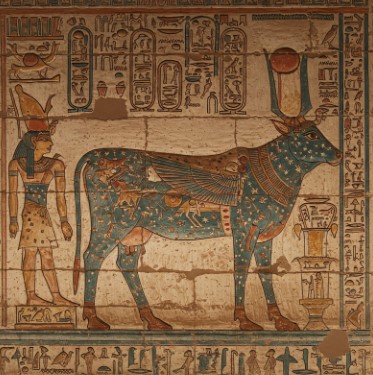
Hathor is one of the most important and multifaceted goddesses in ancient Egyptian mythology. Often associated with love, beauty, music, dance, fertility, and motherhood, she embodies the nurturing aspects of femininity and the joy of life. Her name translates to “House of Horus,” indicating her connection to the sky and the divine.
Origins and Family
Hathor is often depicted as a cow, a woman with cow horns, or a woman adorned with a headdress of cow horns and a sun disk. She is the daughter of Ra, the sun god, and is sometimes considered the mother or consort of Horus, the sky god. In some myths, she is also linked to Osiris and Isis, further intertwining her with the Osirian mythos.
The Goddess of Joy and Music
Hathor is celebrated as the goddess of music and dance. She was believed to bring joy and happiness to the world, often depicted in scenes of festivity, playing musical instruments, and leading celebrations. Her festivals were lively events filled with music, dance, and feasting, where people would honor her and seek her blessings for love and fertility.
The Protector of Women and Children
As a goddess of motherhood and fertility, Hathor was revered by women, especially those who were pregnant or seeking to conceive. She was often invoked for protection during childbirth and was seen as a nurturing figure who safeguarded mothers and their children. Temples dedicated to Hathor often served as places of healing and support for women.
The Duality of Hathor
Hathor also embodies a dual nature. While she represents joy and love, she can also take on a more fearsome aspect as the “Eye of Ra.” In this form, she is a fierce protector, often depicted as a lioness or a woman with lioness features. When the sun god Ra became angry with humanity, Hathor would unleash her wrath, sometimes taking the form of Sekhmet, the lioness goddess of war and destruction. This duality reflects the complexities of life, where joy and sorrow, love and wrath coexist.
The Myth of Hathor and the Destruction of Humanity
One of the most famous myths involving Hathor is the story of her role in the punishment of humanity. According to the myth, Ra grew weary of humans who had become disrespectful and disobedient. In his anger, he sent Hathor to punish them. She transformed into Sekhmet and began to wreak havoc, killing many. However, realizing the devastation she was causing, Ra sought to stop her. He devised a plan to intoxicate her with beer dyed red to resemble blood. When she drank it, she became so inebriated that she forgot her wrath and returned to her gentle form as Hathor, thus saving humanity.
Worship and Temples
Hathor was worshipped throughout Egypt, with her most significant temple located at Dendera. This temple is famous for its beautiful reliefs and inscriptions that depict her in various forms and roles. Pilgrims would visit her temples to seek blessings for love, fertility, and protection.
Legacy
Hathor’s influence extended beyond ancient Egypt, as she was often associated with other cultures and deities in the region. Her image and attributes have persisted through time, symbolizing the enduring nature of love, joy, and motherhood.
Perspective
Hathor is a goddess of great significance in Egyptian mythology, one which represents the joys of life, the nurturing aspects of femininity, and the complexities of human emotion. Her stories reflect the duality of existence, celebrating both the light and dark aspects of life.

 Archaic Wisdom